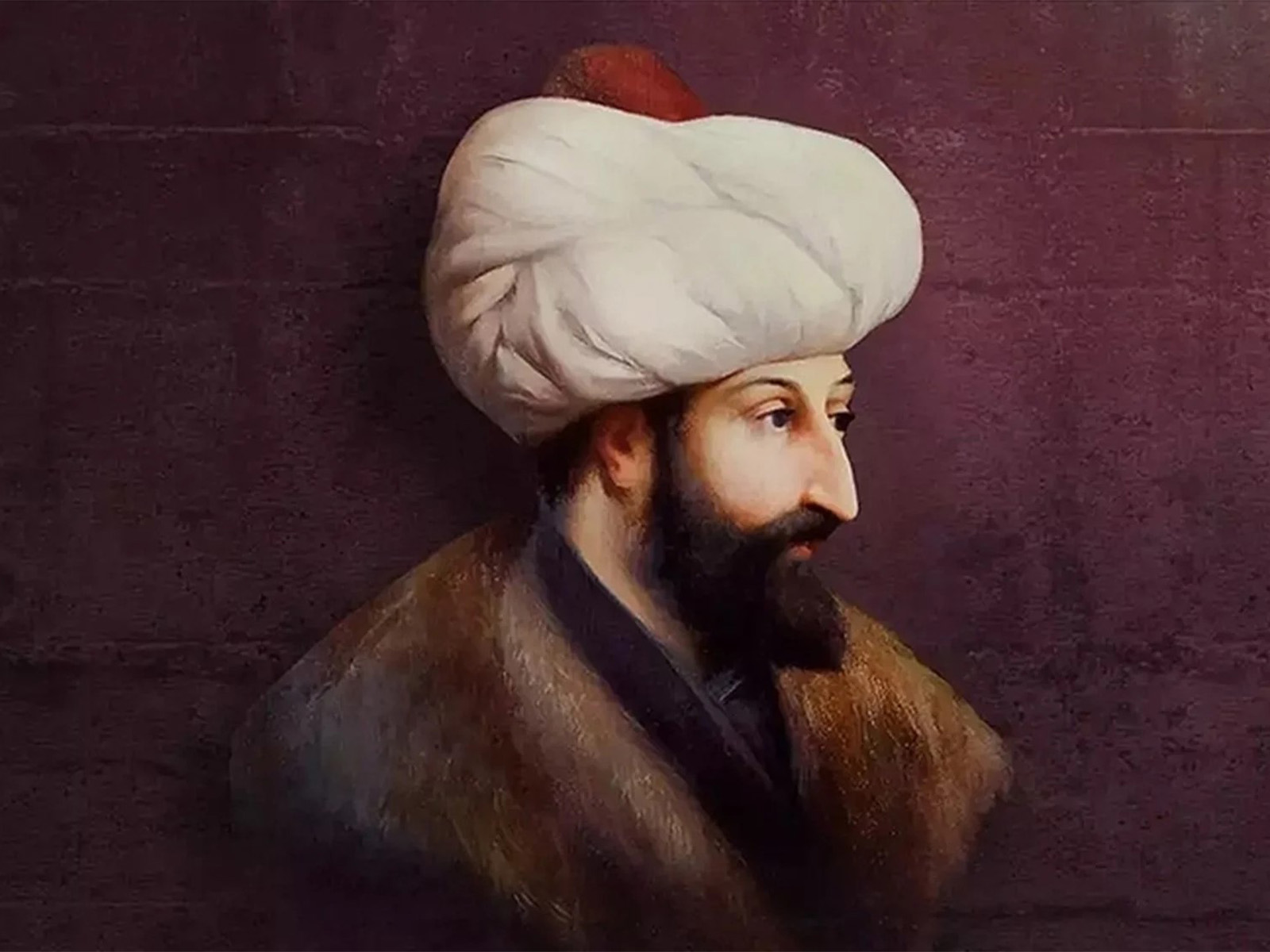
Mehmed II — Mehmed the Conqueror
Mehmed II was born in Edirne in 1432. When he ascended to the Ottoman throne as the seventh ruler of the Ottoman dynasty, he was only twelve and a half years old. Çandarlı Halil Pasha’s duty was to assist the young sultan. His father, Murad II, had abdicated in favor of his son and retired to Manisa, where he wanted to spend his time reading and reflecting. When the Crusader army began gathering after hearing that Mehmed II had ascended the throne, Mehmed informed his father. Murad II immediately returned, took command of the army, and defeated the Crusaders. He then once again handed the throne back to Mehmed and returned to Manisa. Çandarlı Halil Pasha was deeply unhappy with this situation. He attempted to weaken Mehmed II by organizing a Janissary uprising. Together with Murad II, Çandarlı planned to have Sultan Mehmed taken outside the city under the pretext of a hunting expedition, while Murad II would secretly be brought back to the palace and proclaimed sultan. Murad II returned as planned, and in 1446, when Mehmed was fourteen years old, Mehmed withdrew to Manisa. Murad II died in 1451 at the relatively young age of forty-seven. Mehmed II, who was then nineteen years old, was proclaimed sultan once again, with the support of Çandarlı Halil Pasha. After ascending the throne, Mehmed II formed a Divan, or imperial council, in which his own supporters held the majority. However, he knew that Çandarlı had considerable influence over the Janissaries and that he needed to maintain good relations with him for a while. Therefore, he appointed Çandarlı Halil Pasha as his Grand Vizier. Before Mehmed II, the Turks had attempted to conquer Constantinople four times. After becoming sultan, Mehmed II immediately began preparations for the conquest. First, he considered it necessary to build Rumeli Fortress in order to prevent possible military reinforcements from passing through the Bosphorus. He chose a location directly opposite Anadolu Fortress, which had previously been built by Bayezid I. Construction of Rumeli Fortress began in April 1452. Between five and six thousand workers took part in its construction, and the fortress was completed in approximately four months. Its three enormous towers are among the largest fortress towers in the world. Meanwhile, Mehmed II spent two years expanding his navy and began commissioning the production of large cannons. The production of cannons began in Edirne and in Demirciköy, Kırklareli. Around sixty different cannons were cast. One of them was the famous Şahi cannon, which was reportedly designed and built by an engineer named Urban, who is said to have escaped from the Byzantine dungeons. The Ottoman navy was also prepared to provide support for the siege from the sea.
The Siege of Constantinople
March 23, 1453
The Ottoman army departed from Edirne.
April 2, 1453
The Ottoman army arrived at Constantinople. Mehmed II called upon the city to surrender, but Emperor Constantine XI refused.
April 6, 1453
The first major attack took place. The siege lasted for 53 days, with periods of intense fighting and intervals of relative calm. The city was defended by Emperor Constantine XI.
April 11, 1453
The Ottomans identified the weakest sections of the city’s defenses and positioned their cannons accordingly.
April 12, 1453
The Ottoman artillery bombardment began. At the same time, the Byzantines used Greek fire as one of their defensive weapons.
April 20, 1453
Three Genoese ships sent by the Pope and a Greek cargo ship from Sicily appeared off the city. A naval battle took place in the Sea of Marmara, during which several Ottoman ships suffered heavy losses. According to the account, 23 Christians and 300 Turks were killed. The main reason for the Ottoman defeat was the greater height of the Italian ships compared with the Ottoman vessels. Because the Ottoman cannons could not fire effectively upward, the Italian ships were able to maintain an advantage. As a result, the ships succeeded in entering the Golden Horn in the evening.
April 21, 1453
After the defeat at sea, which allowed the Genoese ships and the Greek cargo ship from Sicily to enter the city, Mehmed II went to the naval headquarters and replaced the naval commander, Baltaoğlu Süleyman Bey, with Hamza Bey, who was appointed as the new admiral.
April 22–23, 1453
Realizing that he had to somehow bring his fleet into the Golden Horn, Mehmed II decided to transport his ships overland. For this purpose, he had wooden planks laid along a route stretching from the area of present-day Dolmabahçe Palace to Kasımpaşa. Using this route, approximately 70 ships were transported overland on rollers and launched into the Golden Horn by the following morning. As a result, the Ottomans gained control of the Golden Horn. The Ottoman artillery positioned in Galata began bombarding the city together with the ships stationed in the Golden Horn. The Byzantines were therefore forced to move troops to the walls of the Golden Horn. However, because of the long distance, the Ottoman artillery was unable to seriously damage the walls. While the mutual bombardment continued across the Golden Horn, the walls around the Romanus Gate were also bombarded. The Ottomans increased the number of mobile siege towers. These towers were taller than the city walls and had small cannons installed inside them. They were used to prevent the Byzantines from repairing the breaches opened in the walls. The ditches, which had become filled with pieces of the collapsed walls, gave the Ottoman army opportunities to launch attacks. However, the Byzantine defenders continued to inflict casualties on the Ottoman forces, and four of the mobile siege towers were burned.
May 6, 1453
Believing that the city walls had been weakened sufficiently, Mehmed II launched an assault on the evening of May 6. However, the attack failed, and the Ottoman army, having suffered heavy losses, was forced to withdraw. Following this assault, the Romanus section, which was one of the most heavily damaged parts of the walls, was reinforced with approximately 400 Venetian sailors. Meanwhile, by the seventh week of the siege, the Ottomans had still not achieved a decisive result. At this point, Çandarlı Halil Pasha persuaded Mehmed II to make one final offer of surrender to the emperor. However, the emperor rejected the offer once again. Mehmed II then announced that he would launch a major attack by land and sea between May 24 and May 29.
May 29, 1453
The final assault began. Sultan Mehmed divided his army into three groups. The first group consisted of irregular troops and volunteers. The second group consisted mainly of Muslim peasants who had joined the army. The third and most elite group consisted of the Janissaries. During the fighting, the wounding and subsequent withdrawal of the commander-in-chief, Giovanni Giustiniani, from the battlefield caused a major loss of morale among the defenders of the city. Finally, in the early morning hours, Ottoman soldiers entered the city through a small gate known as Kerkoporta and raised the Ottoman flag on the tower above the gate. When Mehmed II reached Hagia Sophia, he knelt down, prostrated himself, and kissed the ground. He then declared that nothing would be done to the large crowd that had taken refuge inside the church and that their lives would be spared. The siege began on April 6, 1453, lasted for 53 days, and ended on May 29, 1453. This great victory earned Mehmed II the title “Fatih,” meaning “the Conqueror,” in the Islamic world.

Get in touch now
Ready for an unforgettable tour?