TURKIYE: WHERE HISTORY, CULTURE AND CIVILIZATIONS MEET
Türkiye, located at the crossroads of Europe and Asia, is one of the world’s most remarkable countries, with a history spanning thousands of years, a rich cultural heritage, breathtaking natural landscapes, and cities shaped by numerous civilizations. Surrounded by seas on three sides, Türkiye offers an extraordinary variety of landscapes, from mountains and valleys to ancient cities, palaces, mosques, churches, museums, and unique culinary traditions. The foundation of modern Türkiye emerged from the Turkish War of Independence, led by Mustafa Kemal Atatürk, and culminated in the establishment of the Republic of Türkiye.
THE BIRTH OF THE REPUBLIC OF TÜRKİYE
19 May 1919 – The beginning of the Turkish National Struggle:
Mustafa Kemal Pasha’s arrival in Samsun is regarded as the beginning of the process that led to the establishment of the Republic of Türkiye. The Amasya Circular, the Erzurum Congress, and the Sivas Congress followed, strengthening the principles of national sovereignty and independence.
23 April 1920 – The opening of the Grand National Assembly of Türkiye:
The Grand National Assembly was opened in Ankara. Ankara became the political center of the National Struggle, and the principle that sovereignty belongs to the people became one of the foundations of the new state.
1 November 1922 – Abolition of the Sultanate:
The Grand National Assembly abolished the Ottoman Sultanate, bringing the Ottoman monarchy’s political rule to an end.
24 July 1923 – The Treaty of Lausanne:
The Treaty of Lausanne was signed, internationally recognizing the independence and sovereignty of the new Turkish state.
13 October 1923 – Ankara becomes the capital:
Ankara officially became the capital of Türkiye. Istanbul had previously served as the capital of the Ottoman Empire for centuries. After the Ottoman conquest of Constantinople in 1453, Istanbul became the political, economic, and cultural center of the empire. With the establishment of the Republic, however, the capital was moved to Ankara.
29 October 1923 – The Republic of Türkiye is proclaimed:
The Republic of Türkiye was officially proclaimed. Mustafa Kemal Atatürk was elected as the first President of the Republic of Türkiye.
Today, 29 October is celebrated throughout the country as Republic Day, one of Türkiye’s most important national holidays.
MUSTAFA KEMAL ATATÜRK AND THE NEW TÜRKİYE
Mustafa Kemal Atatürk was the founder and first President of the Republic of Türkiye. As the military and political leader of the Turkish War of Independence, he played the central role in establishing the Republic. Following its foundation, he introduced a comprehensive program of reforms aimed at transforming Türkiye into a modern, independent and contemporary state. Atatürk’s vision went beyond establishing a new state. He sought to modernize Turkish society and institutions in areas including education, law, government, the economy, and social life.
Some of the most important reforms of the early Republican period included:
3 March 1924 – Unification of Education:
The Law on the Unification of Education was adopted, bringing educational institutions under the authority of the Ministry of Education.
3 March 1924 – Abolition of the Caliphate:
The Caliphate was abolished, marking an important step toward establishing the secular structure of the new Republic.
17 February 1926 – Adoption of the Turkish Civil Code:
The Civil Code was adopted, introducing major changes to family law, marriage, divorce and inheritance. It established important principles of equality between women and men within civil law. The law came into force on 4 October 1926.
25 November 1925 – Hat and clothing reforms:
As part of the modernization policies of the Republic, new regulations regarding clothing and public appearance were introduced.
1 November 1928 – The Alphabet Reform:
The Latin-based Turkish alphabet replaced the Arabic script previously used for Turkish. Nationwide educational campaigns were launched to help people learn and adopt the new alphabet.
21 June 1934 – The Surname Law:
The Surname Law was adopted, requiring Turkish citizens to have a family surname.
24 November 1934 – The surname “Atatürk”:
The Turkish Grand National Assembly granted Mustafa Kemal the surname Atatürk, meaning “Father of the Turks.”
5 December 1934 – Women’s right to vote and stand for election:
Turkish women gained the right to vote and stand for election in parliamentary elections. Women’s participation in local government had already been expanded through municipal elections on 3 April 1930 and village elections on 26 October 1933. Turkish women participated in parliamentary elections for the first time on 8 February 1935.
5 February 1937 – Secularism becomes a constitutional principle:
The principle of secularism was incorporated into the Constitution as one of the fundamental characteristics of the Republic of Türkiye. These reforms played a major role in transforming Türkiye from an imperial system into a modern republican state.
TÜRKİYE TODAY
Türkiye is a republic consisting of 81 provinces. Its capital is Ankara, while Istanbul is its largest and most populous city. As of the end of 2025, Türkiye’s population was 86,092,168. Istanbul is by far the country’s most populous city, with approximately 15.75 million residents. The first President of the Republic of Türkiye was Mustafa Kemal Atatürk. The current President of Türkiye is Recep Tayyip Erdoğan. Türkiye is constitutionally a democratic, secular and social state governed by the rule of law. Its population is diverse, with people representing different cultural backgrounds, beliefs, lifestyles and traditions. Women play an active role in every aspect of Turkish society, including education, professional life, politics, business, culture and social life. Like any country, Türkiye has different conditions depending on the region and city. Istanbul, Ankara, İzmir, Antalya, Cappadocia and the country’s major tourist destinations welcome millions of domestic and international visitors every year. Visitors are encouraged to follow standard travel-safety practices and local guidance.
TÜRKİYE’S GEOGRAPHY AND NATURAL BEAUTY
Türkiye has an extraordinary geographical diversity due to its unique location. The country is surrounded by the Black Sea, the Sea of Marmara, the Aegean Sea and the Mediterranean Sea. The Bosphorus and the Dardanelles are two strategically important waterways connecting Europe and Asia. Türkiye experiences four distinct seasons, although the climate varies considerably from one region to another. The Black Sea region is known for its lush landscapes and frequent rainfall, while the Aegean and Mediterranean coasts enjoy hot, sunny summers. Eastern Türkiye experiences much colder and longer winters.
Among Türkiye’s most remarkable natural attractions are:
- The fairy chimneys and valleys of Cappadocia
- The white travertines of Pamukkale
- Fethiye and Ölüdeniz
- The Mediterranean coastline of Antalya
- Kaş and Kekova
- Bodrum and Çeşme
- The lush highlands of the Black Sea region
- Mount Ararat
- Lake Van
- Lake Salda
- Uludağ
- Mount Nemrut
- Saklıkent and numerous national parks
HISTORY AND TOURISM
One of Türkiye’s greatest treasures is the remarkable number of civilizations that have left their mark on the same land. The Hittites, Phrygians, Lydians, Persians, Hellenistic kingdoms, Roman and Byzantine Empires, Seljuks and Ottomans have all contributed to the history and cultural heritage of Anatolia. As a result, visitors can often travel only a few hours and find themselves surrounded by monuments and archaeological sites belonging to completely different periods of history.
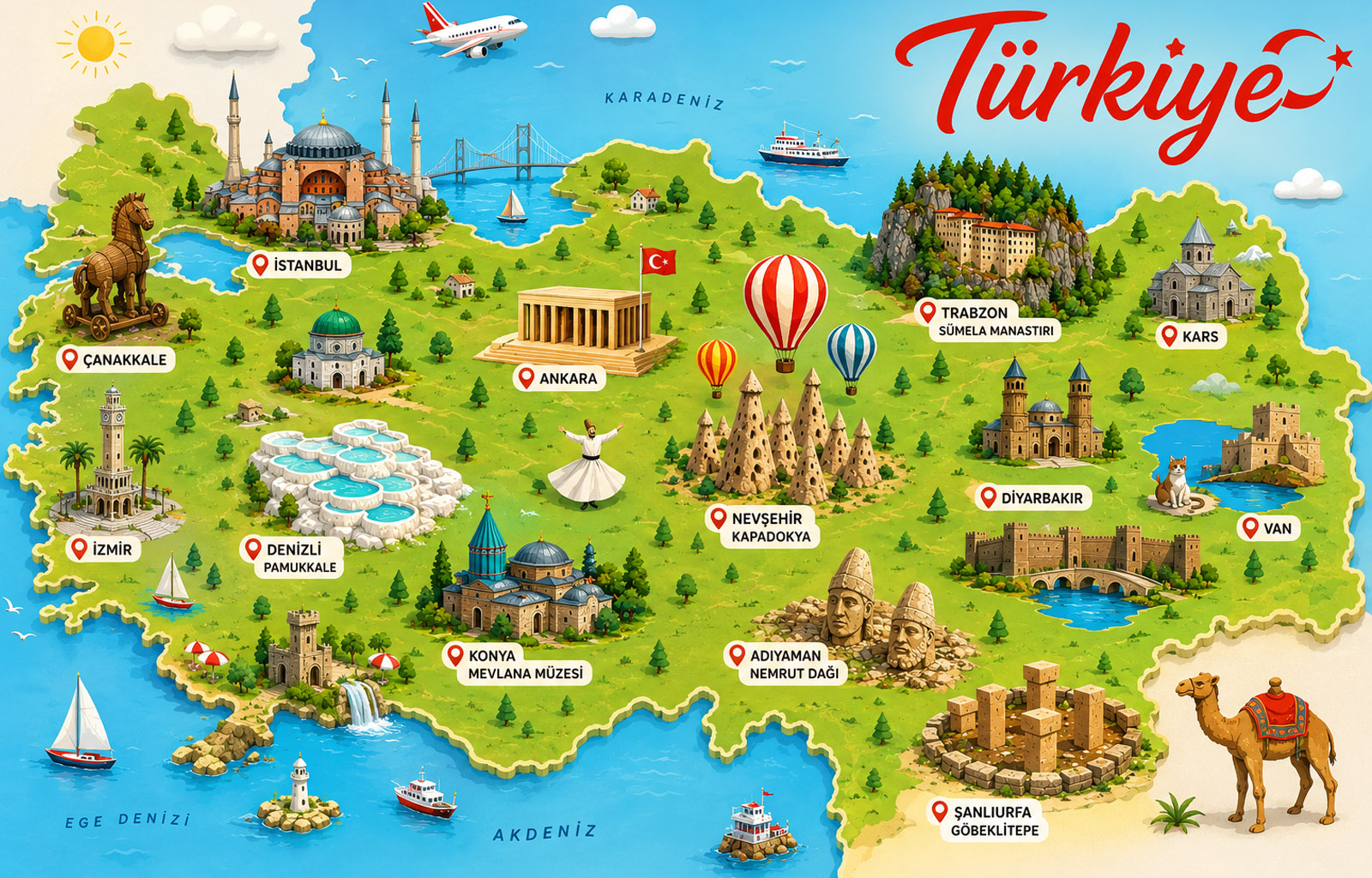
Istanbul is one of Türkiye’s most important tourist destinations, with an extraordinary historical heritage shaped by the Roman, Byzantine and Ottoman periods. Hagia Sophia, Topkapı Palace, the Blue Mosque, the Basilica Cistern, the Grand Bazaar, the Spice Bazaar, Galata Tower, the Bosphorus and Dolmabahçe Palace are among the city’s most famous attractions.
Cappadocia, famous for its fairy chimneys, valleys, underground cities, rock-cut churches and hot-air balloons, is one of the world’s most extraordinary destinations.
Ephesus, one of the most impressive ancient cities of the Roman world, is a major destination for history and archaeology enthusiasts.
Pamukkale and Hierapolis, combining spectacular white travertines with an ancient city, are among Türkiye’s best-known attractions.
Other important destinations include Antalya, Bodrum, Fethiye, Marmaris, Çeşme, Alaçatı, Şanlıurfa, Mardin, Gaziantep and Trabzon, each offering its own distinctive culture, history and landscape.
TURKISH CUISINE
Turkish cuisine is one of the richest and most diverse culinary traditions in the world, reflecting the history and regional cultures of the country. Kebabs, beef döner ( döner), Turkish-style flatbread with minced meat (lahmacun), Türkish flatbrerad (pide), Turkish dumplings filled with minced meat, served with yogurt and garlic ( mantı) mantı, Turkish appetizers (meze) , stuffed vegetables, (stuffed vine leaves/ stuffed grape leaves (sarma), Türkish meatballs (köfte), Turkish savory pastry (börek), Turkish baklava- Turkish layered pastry with nuts and syrup, Turkish shredded pastry dessert with cheese and syrup (kunefe), Turkish delight, Turkish coffee and Turkish tea are among Türkiye’s most internationally recognized specialties.
Every region has its own culinary identity. The baklava and kebabs of Gaziantep, the cuisine of Hatay, the corn- and fish-based dishes of the Black Sea, the olive-oil dishes of the Aegean region and the vegetable and seafood dishes of the Mediterranean are just a few examples of this incredible diversity.In Turkish culture, food is about much more than eating. A shared table represents hospitality, conversation, friendship and togetherness.
TURKISH CULTURE AND HOSPITALITY
One of the most distinctive characteristics of Turkish culture is hospitality. In Türkiye, guests are traditionally welcomed with generosity and warmth. Offering tea or coffee, sharing food, helping visitors find their way and offering assistance when needed are all natural parts of everyday social life. Turkish culture has been shaped by strong family ties, neighborhood relationships, tea and coffee traditions, traditional crafts, music, dance, festivals and the unique lifestyles of different regions. At the same time, Türkiye’s major cities are vibrant and modern, bringing together contemporary lifestyles, different cultures, art, gastronomy, international communities and a dynamic social environment.
FROM “TURKEY” TO “TÜRKİYE”
Türkiye’s official international name underwent an important change in 2022. On 1 June 2022, Türkiye formally requested that the country be referred to as “Türkiye” rather than “Turkey” in international contexts, including at the United Nations.
The United Nations accepted the request, and on 3 June 2022, announced that the country’s official name would be used as “Türkiye” within the United Nations system. Today, Türkiye is the country’s official international name.
WHAT MAKES TÜRKİYE UNIQUE?
Perhaps the most remarkable feature of Türkiye is the way the past and the present exist side by side. On one side, visitors encounter thousands of years of history: ancient cities, Roman and Byzantine monuments, Seljuk heritage and Ottoman palaces. On the other, they discover modern cities, universities, cultural centers, contemporary art, technology, gastronomy and international communities. Türkiye is much more than a geographical bridge between Asia and Europe. It is a living meeting point of civilizations, cultures and traditions. From the Bosphorus of Istanbul to the valleys of Cappadocia, from the ancient cities of the Aegean coast to the turquoise bays of the Mediterranean, and from the lush highlands of the Black Sea to the historic cities of Southeastern Anatolia, Türkiye offers the opportunity to experience many completely different worlds within a single country. At the heart of this story of modern Türkiye stands the Republic of Türkiye, founded under the leadership of Mustafa Kemal Atatürk. The War of Independence led by Atatürk and the establishment of the Republic represent one of the most important turning points in Türkiye’s modern history. The reforms that followed reshaped education, law, society, women’s rights, culture and government, helping define the direction of the modern Turkish state.
Today, Türkiye is a country that protects its history, preserves its cultural heritage, celebrates its natural beauty and brings traditional values together with modern life. A visitor to Türkiye does not simply discover a country. They discover thousands of years of history, the legacy of countless civilizations, a rich culinary tradition, a vibrant culture and the warmth of Turkish hospitality—all within one extraordinary destination.