
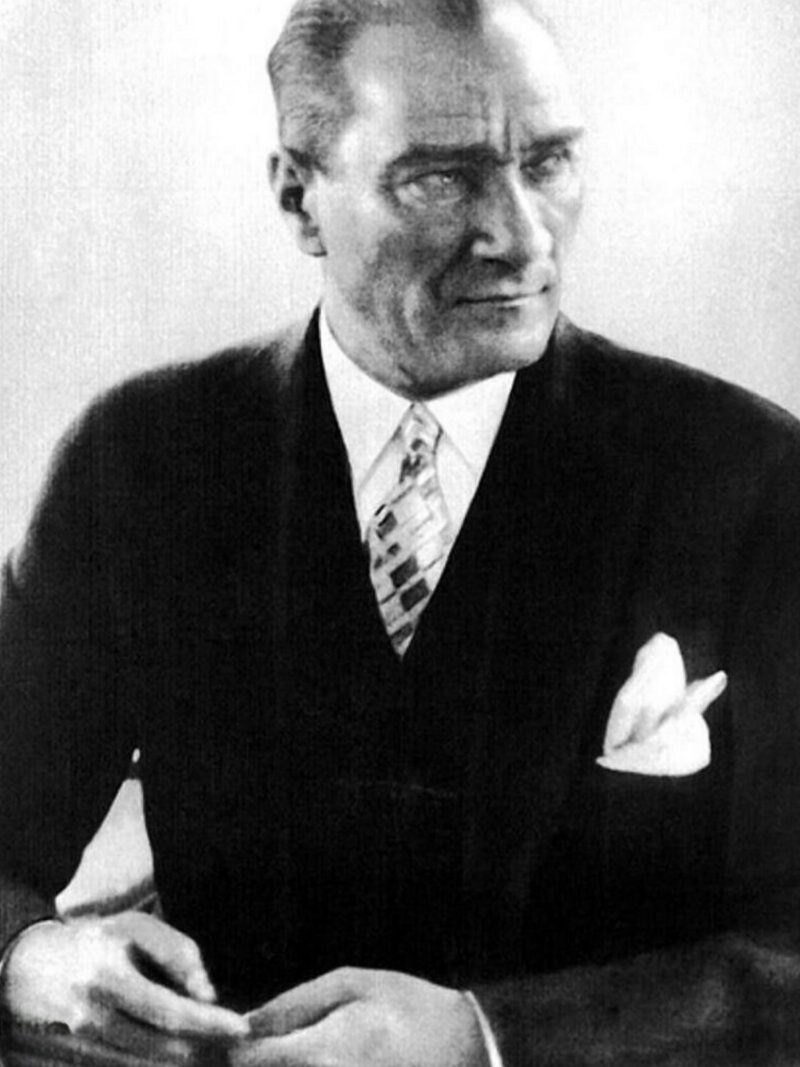
Mustafa Kemal ATATÜRK
Mustafa Kemal Atatürk was the founder and first president of the Republic of Turkey. He was born in 1881 in Thessaloniki. Before he even finished primary school, his father passed away. After his father’s death, in 1893, he entered the Military Rüştiye (secondary school), which he had long wished to attend. His mathematics teacher, Captain Mustafa Efendi, impressed by the young student’s intelligence and abilities, added the name “Kemal” to distinguish him from the other students named Mustafa in the class. He took French lessons and later entered the Military Academy in Istanbul. On February 10, 1902, he graduated with the rank of lieutenant and continued his education at the War Academy. He became a first lieutenant in 1903 and graduated from the War Academy on January 11, 1905, as a staff captain. His first assignment in 1905 was in Damascus, in the Syrian region. Later, he served in various regions. After the Gallipoli Campaign in 1915, he was promoted to colonel.
Following World War I, on May 19, 1919, he went to Samsun and initiated the national struggle that would result in the expulsion of occupying forces and the proclamation of the Republic. He passed away on November 10, 1938, at Dolmabahçe Palace in Istanbul. His body was first placed in the Ethnography Museum in Ankara as a temporary burial site and was later transferred on November 10, 1953, to Anıtkabir, which had been built in his honor.
His father named him Mustafa; the name was also his grandfather’s name. His father, Ali Rıza Efendi, died at the age of 47 from intestinal tuberculosis. His mother, Zübeyde Hanım, married Ragıp Abbas, who was also a widower with four children. Mustafa was only 15 years old when his mother remarried. He had two brothers named Ahmet and Ömer, but he lost them to a smallpox epidemic when he was only two years old. Before Mustafa was born, his sister Fatma had died of tuberculosis. When Mustafa was 16, his youngest sibling Naciye also passed away, leaving only his sister Makbule alive. On January 14, 1923, at dawn, his mother Zübeyde Hanım passed away. Mustafa Kemal could not attend the funeral; instead, his closest friend Salih Bozok attended. At Mustafa Kemal’s request, a modest funeral ceremony was held. He asked that it not be luxurious or extravagant and said that a simple stone should be placed at her grave with the inscription: “Atatürk’s mother Zübeyde is buried here,” and that a children’s park should be built nearby because his mother loved children very much.
In 1936, Mustafa Kemal Atatürk wrote a 44-page book titled Geometri, in which he introduced Turkish equivalents for Arabic and Persian geometric terms. On November 1, 1922, he abolished the Sultanate. In 1924, he abolished the Caliphate, separating religion and state affairs. On October 29, 1923, he proclaimed the Republic. In 1924, Turkey’s first school for the disabled was opened in Izmir. The medreses were closed in 1924. In 1925, he introduced the Hat and Dress Reform. In the same year, dervish lodges, convents, and tombs were closed.
In 1926, Islamic law was abolished; monogamy was introduced and civil marriage became compulsory, establishing equal legal status for women and men. The Turkish Civil Code was adopted in 1926. In 1928, the Arabic alphabet was replaced with the Latin alphabet through the Alphabet Reform, which he personally promoted. The first official beauty contest was organized in 1929 by the newspaper Cumhuriyet under his directive. In 1932, he founded the Turkish Language Association. In 1934, with the Surname Law, every family was given a surname. The calendar, clock, and measurement systems were adapted to international standards. In 1934, women were granted the right to vote and to be elected as members of parliament.
In 1927, he wrote the Nutuk (The Great Speech), which took three months to complete and covered the period between May 19, 1919, and October 20, 1927. The main text consisted of 534 pages, along with 308 pages of letters, telegrams, and other documents. He was both the author and the scribe. He personally delivered it from the podium of the Turkish Grand National Assembly. The speech lasted six days, six hours per day, totaling 36 hours and 31 minutes. It was first published in Ottoman Turkish in 1927 and has been published in modern Turkish since 1934.
Mustafa Kemal Atatürk did not carry a wallet; his salary was received and managed by his aide-de-camp. He retired in 1927 with the rank of Field Marshal and received a pension of 150 Turkish lira. His total service period was 41 years, 3 months, and 29 days; in fact, 28 years, 3 months, and 29 days of this period covered the time from his entry into the Military Academy until his retirement.
He wore size 42 shoes and carried a pocket watch. His prayer beads were usually made of 33 beads, and he also had a 99-bead coral rosary with a silver tassel, which he carried as an accessory. He wore two small amulets attached to his undershirt. In his later years, he used Ray-Ban sunglasses. He had a walking stick with a snakeskin handle; the most famous one had a trigger mechanism capable of firing a single bullet.
He was not selective about food and ate whatever his cooks prepared. He was fond of dried beans and used to say he had grown accustomed to their taste at school. He liked okra, fried eggplant, and karnıyarık, often mixing them with rice. He avoided bread and, unless traveling, did not eat breakfast. At noon, he would usually have a glass of ayran and a slice of bread, dipping the bread into the ayran in small pieces. He did not like desserts but could never refuse rose jam. He loved ice cream. In 1911, while on his way to Tripoli, he craved ice cream intensely; his close friend Nuri Conker later joked that he somehow managed to find ice cream in the middle of the desert where even water was scarce.
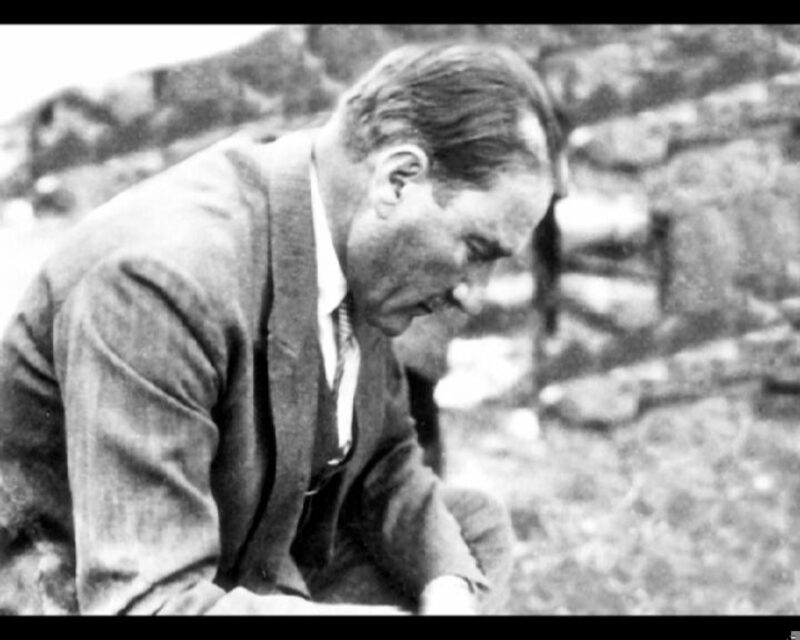
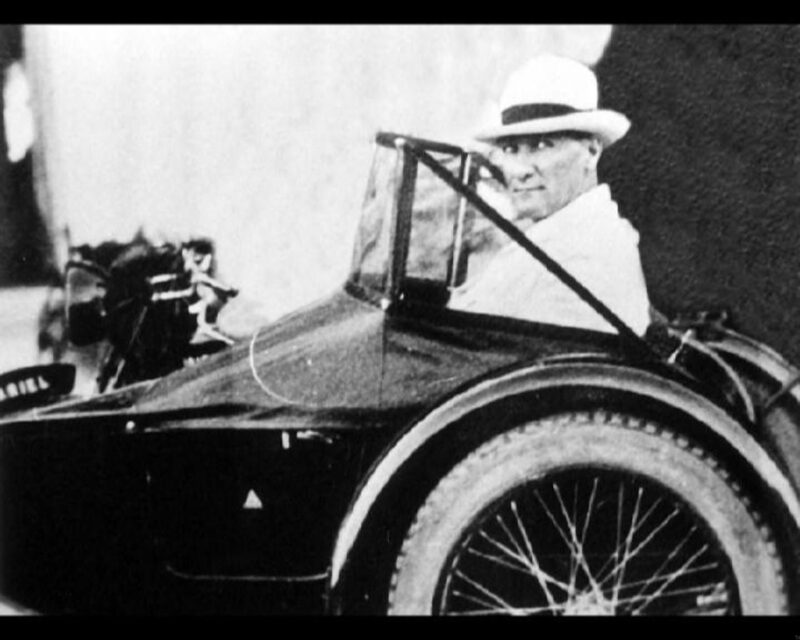
He was 1.74 meters tall and weighed 74 kilograms. His favorite sport was wrestling, and after the age of 50, he learned to swim. To encourage equestrianism, he initiated the tradition of the Gazi Race; the first Gazi Race was held in Ankara in 1927. He was the first statesman in the world to make physical education a compulsory subject in schools and the first to declare a national sports day. He planted his first tree at the age of six, and his favorite flower was the red carnation. He established Ankara’s first orchestra and had a keen interest in Baroque music.
In the 1930s, cirrhosis was widespread and caused many deaths. At the age of 15, he contracted malaria. In 1911, while preparing to depart for Tripoli, he was injured in an accident. In 1912, while in Derna, he suffered from severe dental problems; he had cavities that turned into abscesses, and there was no dentist available. During fighting to seize the ruins of Kasr al-Harun in Derna, a fragment of limestone struck his left eye, filling it with blood and causing burns around it. He initially refused to go to the hospital, but about a year later, in 1912, he went to Egypt and received treatment for ten days.
In August 1915, at Conkbayırı during the Gallipoli Campaign, shrapnel struck his right chest; it hit his pocket watch, which prevented a fatal wound, though he was seriously injured. That same year, he suffered high fever and severe chills after being exposed to heavy rain and contracted malaria again. In 1918, he stayed for a month in room 101 of the Pera Palace Hotel, suffering from intense kidney pain; an inflammation caused by E. coli was detected in his left kidney.
In 1919, while making final preparations to depart for Samsun, he caught the Spanish flu. In April 1919, he experienced a severe stomach illness with painful cramps and recovered only after 17 days. In May 1919, shortly after arriving in Samsun, he contracted malaria again—his eleventh bout during his lifetime.
In March 1921, during the Second Battle of İnönü, a boil developed on his left side, which suddenly enlarged and became inflamed. On August 16, 1921, on the eve of the Battle of Sakarya in Polatlı, his horse was startled while his foot was in the stirrup, causing him to fall and break three ribs on his left side. His chest was tightly bound with wooden splints, and blood accumulated around the fractured area. In March 1922, his kidney illness recurred.
On October 29, 1923, when the Republic was proclaimed, he delivered an unusually brief speech of thanks in the parliament because he had just begun using a new dental prosthesis; it hurt his palate and caused a whistling sound while he spoke.
In his final days at Dolmabahçe Palace, his condition deteriorated rapidly. On November 2, he could take only a few spoonfuls of pea purée, orange juice, and salep. On November 3, he managed some buttered bread and grape juice twice. On November 4, he drank milky coffee and water. On November 5, they tried okra purée, but he could only drink salep. On November 6, he consumed only apple juice and milk. On November 7, he drifted in and out of consciousness; for the first time in his life, he craved artichoke, but it could not be found in Istanbul in time. On November 8, he was no longer conscious; at one moment he turned his head to the right and said, “Aleykümselam” (‘Peace be upon you, too’)—his last words. On November 9, he suffered involuntary convulsions and excessive sweating.
On Thursday, November 10, 1938, at 9:05 a.m., Mustafa Kemal Atatürk passed away at the age of 57.
Mustafa Kemal Atatürk devoted his entire life so that the Turkish nation could live on its own land in a democratic and secular system—peacefully, justly, securely, and in freedom and liberty. He was always a man loyal to his country.
Mustafa Kemal Atatürk is the father of the Turkish nation and will always remain so.
Bodies may turn to dust, but ideas never do.