
Underground Cisterns Tour
- Tour name : Underground cisterns tour
- Operates : everyday ( all year round)
- Tour highlights: Basilica Cistern (Yerebatan Cistern), Gülhane Park Cistern, Gülhane Park, Binbirdirek Cistern (Cistern of Philoxenos), Şerefiye Cistern (Theodosius Cistern)
Basilica Cistern (Yerebatan Cistern)
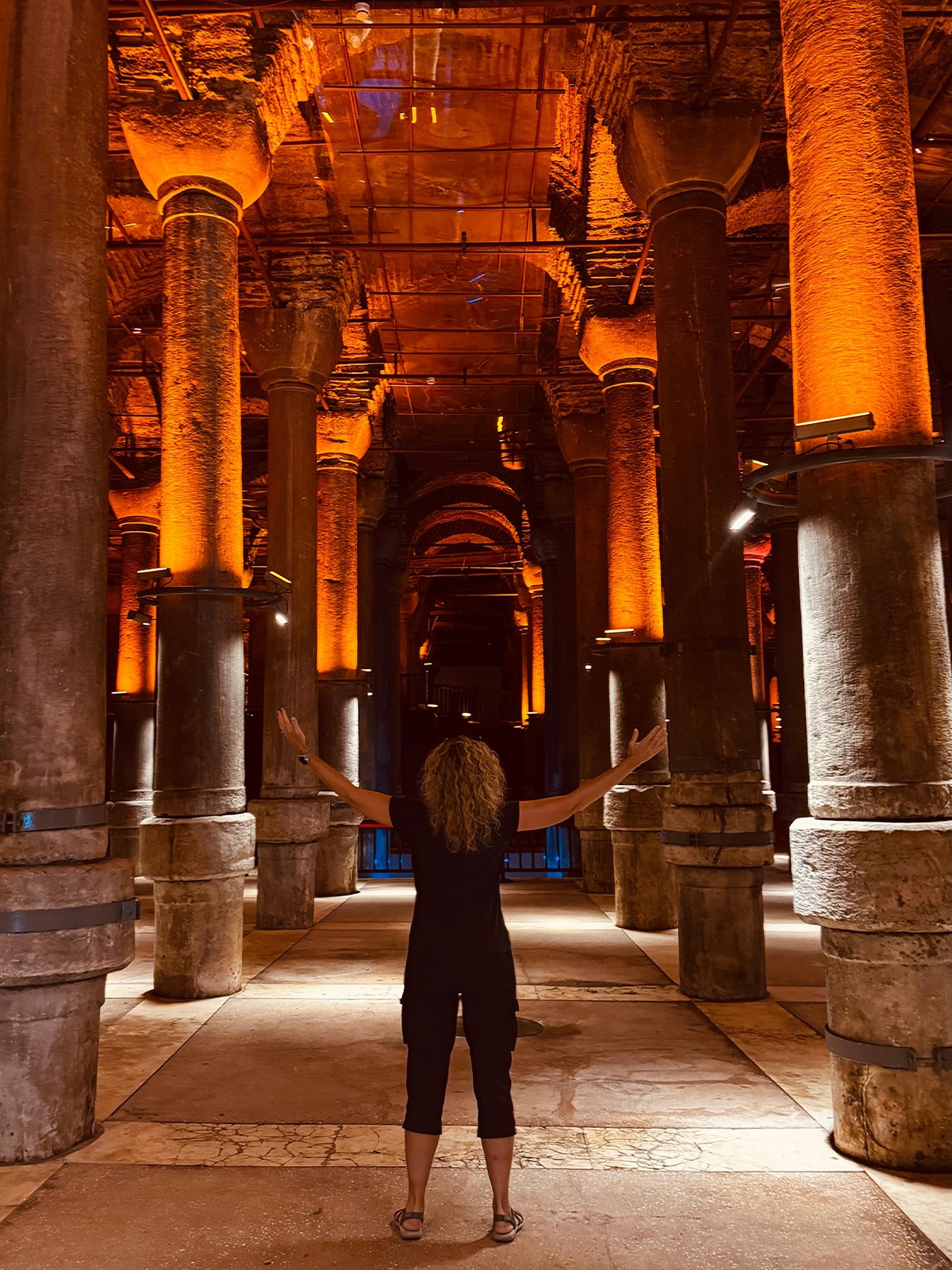
The famous Byzantine emperor Justinian I had the Basilica Cistern built in 532 to supply water to the Great Palace. With its architectural grandeur, it creates the impression of a palace above the viewer, which is why it is popularly known as the “Sunken Palace.” Since it was constructed on the site of the former Basilica of Illus during the Roman period, it is also referred to as the “Basilica Cistern” in foreign sources. The cistern has a capacity of approximately 80 million cubic meters of water, which was brought from the Belgrad Forest, about 25 kilometers away, through a series of aqueducts and tunnels.This 1,500-year-old structure covers an area of 140 by 170 meters. It consists of a total of 336 columns arranged in 28 rows of 12 columns each. Most of the columns are 12 meters high and feature capitals in the Corinthian and Doric styles. At the far end of the cistern, you can see two carved Gorgon heads used as column bases.
According to Greek mythology, the Gorgons were three female monsters with snake hair who turned anyone who looked at them into stone. Among them, only Medusa is widely known. Perseus borrowed the shield of Athena, placed a mirror in front of it, and used it to face Medusa. Seeing her own reflection, Medusa shared the same fate as her victims.
The restoration of the Basilica Cistern began in 1985 and it was opened to the public in 1988. During the Byzantine period, the cistern—also known as the “Sunken Palace”—was used to store water for the Great Palace and other buildings on the First Hill. After the conquest of Istanbul, it supplied water to the gardens of Topkapı Palace.

The Cistern of Philoxenos – ( The Binbirdirek Cistern )
The Binbirdirek Cistern was restored between 1995 and 2002 and opened to visitors. The cistern measures 64 by 56.4 meters, covering an area of 3,610 square meters. This means it is only about one-third the size of the Basilica Cistern, yet it is still the second largest covered cistern in the city.
It is believed to have been commissioned in the second quarter of the 4th century by the Roman senator Philoxenus, who came to the city with Constantine the Great. However, there is evidence suggesting that some parts date back to the 5th or 6th century.
In the 19th century, the cistern was used as a thread workshop, and in more recent times, it served as a storage facility. The original height of the structure—from the floor to the tops of its small brick domes with a herringbone pattern—was about 19 meters. The columns consist of two stacked sections connected by interesting stone joints.
The cistern originally contained a total of 224 double columns arranged in 16 rows of 14 columns each, although 12 of them were walled off shortly after the construction was completed. The column capitals supporting the arches are generally plain, except for some that bear the monograms of stonemasons.
The name “Binbirdirek” is thought to derive either from the phrase “bindirme direk” (overlapping columns), referring to the way the columns are stacked, or from the word “binbir” (one thousand and one), which in Turkish is also used to express abundance.

Theodosius Cistern – ( Şerefiye Cistern )
The Şerefiye Cistern (also known as the Theodosius Cistern) is one of the most impressive underground structures in Istanbul and has a deep-rooted history dating back to the Byzantine period. The cistern was built between 428 and 443 AD during the reign of Theodosius II. Its purpose was to meet the water needs of Constantinople, particularly by storing water for the imperial palace and its surroundings. It continued to be used during the Ottoman period for a long time, although it gradually lost its importance. Architectural features: It contains 32 marble columns, The columns are approximately 9 meters high, It is a large underground structure with a rectangular plan.
Over time, the cistern was buried underground and forgotten. In the modern era, it was brought back to light through scientific excavations and restoration efforts, rather than being “discovered” by a single individual. After extensive restoration work, the cistern was opened to visitors as a museum in 2018.
Gülhane Park Cistern
The cistern in Gülhane Park has a rectangular plan measuring around 17 x 12 meters with a depth of 7 meters. It has 12 columns (four rows with three columns) supporting 20 vaults. The columns have 12 unfinished Corinthian capitals, simple imposts, and bases made of Proconnesian marble. There are masons’ marks on some bases, capitals, and columns. Its walls, which are almost 2 meters thick, are lined with hydraulic mortar. The corners are beveled to strengthen the structure from internal water pressure. Traces of a discharge channel are on its northwest wall, while a terracotta inflow pipe is in one of the vaults. The remains of the superstructure can be seen above the cistern. While its function is uncertain, it could have been connected to a monastery or perhaps a bath. The cistern has been dated between the fifth and seventh centuries.
The cistern was discovered by chance in 1913 during work to turn the outer garden of Topkapı Palace into a public park that began the previous year. It was cleaned and documented in the same year. Five arched openings were made in two of the original walls and a metal staircase was added inside to make the cistern accessible to the public. Several capitals, which were discovered during the excavations at the site, are now on display above the cistern. One Ionic impost capital was added to an additional wall on the northwest wall.
There was a small zoo in Gülhane Park in the second half of the twentieth century, during which time the cistern functioned as its aquarium. It was restored in 2003-2004 and excavations were made above the cistern. In the following years, the cistern was closed to the public. Istanbul Metropolitan Municipality (İBB) opened to the public as Gülhane Sanat art exhibition in 2023.

Gülhane Park
Gülhane Park was once part of the outer gardens of the palace. This area corresponded to the lower part of the ancient Greek city of Byzantion, following the same line as the city walls and the outer walls of Topkapı Palace that you see on the left. The acropolis of Byzantion was located where Topkapı Palace stands today.Covering an area of 100,000 square meters, Gülhane Park offers visitors some of the most beautiful photo opportunities, especially during the tulip festival held in April.
On the left side of the park is the Museum of the History of Science and Technology in Islam, which opened in 2008. The project belongs to the Turkish historian of science Fuat Sezgin, and the museum presents the history of Islamic science and technology between the 9th and 16th centuries.
Within the park, on a hill overlooking Sarayburnu, stands the striking Column of the Goths, notable for its 15-meter height and Corinthian-style capital. According to the Byzantine historian Nicephorus Gregoras, a statue of Byzas, the founder of Byzantium, once stood on top of the column. The inscription on its base, which can barely be read, says “to the fortune that returned with the defeat of the Goths.” This creates some confusion, and it is not certain whether the column was erected for Claudius II Gothicus or for Constantine the Great, both of whom defeated the Goths.
Leaving the park and crossing the street, we walk toward Sarayburnu, where there is a large bronze statue of Mustafa Kemal Atatürk. This monument, created in 1926 by the Austrian sculptor Heinrich Krippel, is historically significant as it was the first statue of a Turkish figure erected in the country.
Mustafa Kemal Atatürk
Mustafa Kemal Atatürk was the visionary leader who led the Turkish nation to victory in the Turkish War of Independence and founded the modern Republic of Turkey in 1923. He introduced groundbreaking reforms to transform society, strongly supported women’s rights by granting them equal political participation, and devoted his life to building a modern, independent, and united nation.

Get in touch now
Ready for an unforgettable tour?